
You can’t see the membrane
Locating a breach means moving rock by hand. Water that got in ran sideways under a loose sheet before it ever found an opening in the deck.
Commercial leak detectionA ballasted EPDM roof is loose-laid black rubber held down by roughly ten to twelve pounds of washed river rock per square foot. It’s cheap, it lasts, and it’s miserable to diagnose. John Beal Roofing cores it, weighs the assembly against what the deck can carry, and tells you straight whether to keep it or convert it. Free inspections. (314) 429-6000.
There are a lot of these around the St. Louis metro. Warehouses off Earth City Expressway, office flex in Maryland Heights, plenty of 1980s and 90s buildings where somebody rolled out 45 mil EPDM, lapped the seams, and shoveled stone over the top instead of fastening anything down.
And it works. Wind resistance comes from dead weight, the rock shades the rubber from UV, and some of these roofs are past thirty years old still shedding water. The trouble starts the day one of them finally leaks.
Locating a breach means moving rock by hand. Water that got in ran sideways under a loose sheet before it ever found an opening in the deck.
Commercial leak detectionA thermal scan sees ballast temperature, not the insulation under it. Stone roofs get cores and hand digs instead of a scan.
Infrared moisture scanningTen to twelve pounds a foot is already sitting on your frame. Add saturated insulation and a wet February snow and you’re testing the structure.
Corners and perimeters shed stone first. Bare rubber in a scoured corner is where the next storm starts peeling the sheet back.
Rock walks downhill toward the sumps and plugs them. Every drain needs a strainer and a clean-out that somebody actually checks.
Ponding water on flat roofsGetting ballast off is vacuum trucks, conveyors and dumpster cycles before it’s any roofing at all. We price that line by itself so you can see it.
Tear-off vs recover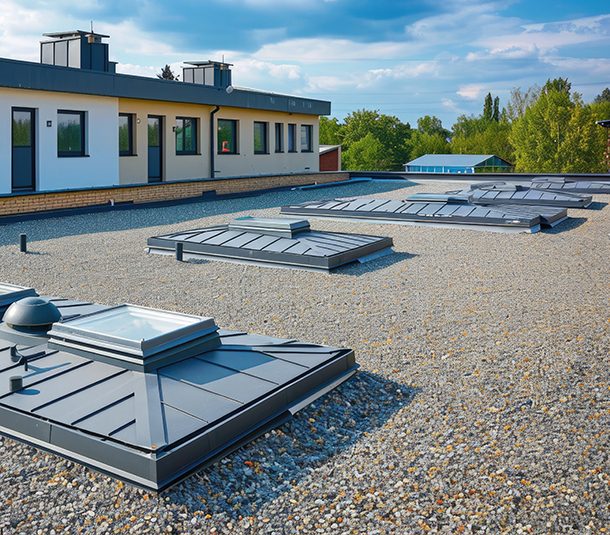
If the sheet is sound, the seams test tight and the insulation comes up dry, leave it be. A ballasted EPDM roof that’s behaving isn’t a roof you replace over its birthday.
We’ll spot-repair seams, re-detail curbs and pitch pans, rake scoured stone back into the corners and put the building on two maintenance visits a year. That buys real time for a fraction of a reroof.
Convert when the insulation’s wet, the deck shows corrosion, or the building is getting solar, new rooftop units or a change of use. Anything that adds load or puts people on the roof weekly argues against stone.
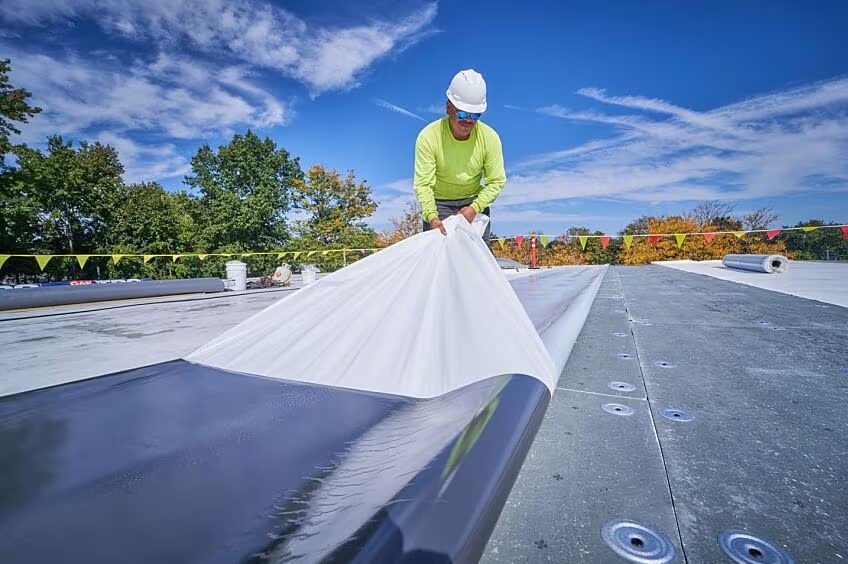
The usual conversion here is ballast off, wet insulation out, new polyiso, then a mechanically attached or fully adhered TPO or PVC over the top. Lighter roof, findable leaks, and a warranty somebody can be held to.
Related: EPDM roofing in St. Louis for adhered and mechanically attached rubber, and TPO vs EPDM vs PVC if you’re deciding what to convert to.
Related: EPDM membrane shrinkage in St. Louis — how shrinkage hides under ballast and shows up at the perimeter.
We work on plenty past thirty years. Stone shields the rubber from UV, which is what kills exposed membrane. Seams, curbs and pitch pans age a lot faster than the field sheet does.
Because the camera reads the top surface, and the top surface is rock. Ballast holds and releases heat on its own schedule, so the image tells you almost nothing about the insulation two inches down. Cores answer it.
Sometimes, but the structural check comes first. You’d be adding array weight to a roof already carrying ten-plus pounds a foot, and most racking wants an attached or adhered membrane under it, not a loose-laid sheet.
It’s a disposal cost, not a salvage credit. Now and then clean washed rock gets reused on the same job when we’re re-ballasting a section, but plan on hauling it off.
Rarely. On most reroofs we’d rather mechanically attach or adhere, because the leak-finding and load penalties follow you for the life of the roof.
Tell us about the property and a dispatcher will call to schedule. No cost, no obligation.
Commercial leaks do not wait for business hours. A live dispatcher answers around the clock and we get crews moving the same night.