
Bridging at the wall
Membrane stretched across the inside corner instead of lying in it. The push test tells you. Often there's a gap opening behind the termination bar too.
Parapet wall flashing repairEPDM shrinkage is an aging rubber membrane slowly losing length and pulling tight at the perimeter, curbs and penetrations. On St. Louis roofs it usually shows up after many years in service as membrane bridging across the wall-to-deck corner, flashing pulled down off parapets and stressed seams. John Beal Roofing re-secures and re-flashes what can be saved and tells you plainly when it can't. Free inspections. Call (314) 429-6000.
Walk up to the base of a parapet on an old EPDM roof and push on the membrane where it turns up the wall. If it's stretched across that corner like a drumhead, with air under it, that's shrinkage. The rubber has pulled back toward the field and it's hanging in space.
That bridged corner is the weak spot. Step on it, let hail hit it, let trapped water freeze behind it, and it tears. The same thing happens at pipe boots, curb corners and drains — anywhere the sheet is locked down on both sides and has nowhere to go. Most of the shrinkage leaks we chase in North County and the older industrial parks along I-70 started right there.
Membrane stretched across the inside corner instead of lying in it. The push test tells you. Often there's a gap opening behind the termination bar too.
Parapet wall flashing repairShrinking field membrane drags the flashing off the base of vent pipes and leaves an open ring at the deck. Small hole. Big stain below.
Older EPDM seams glued with liquid splice adhesive, not tape, tend to let go first once the sheet is under tension. We probe every seam on the survey.
The membrane lifts off the deck around an HVAC curb or a drain bowl. Water ponds at the edge of the tent and works its way under.
HVAC curb leaksStone covers the field, so shrinkage only shows at the edges. We pull back rock along the perimeter to see what the sheet is doing.
Ballasted EPDM roofingOnce water's been getting in at a pulled corner for a few seasons, the iso below is soaked. That turns a repair into a replacement fast.
Wet roof insulation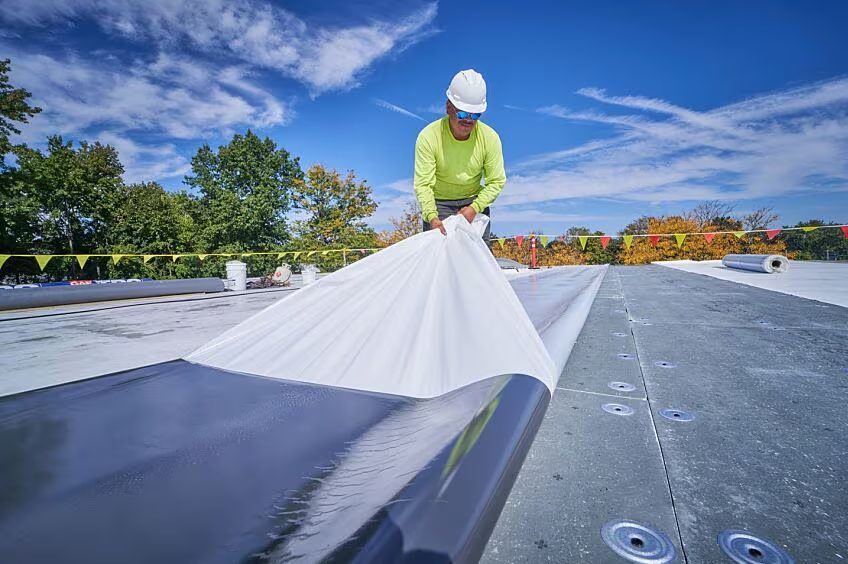
If the rubber's still flexible and the field is dry, it can usually be repaired. We cut the membrane loose at the base of the wall so it relaxes, fasten a securement strip or new row of fasteners there so it can't keep creeping, and run new base flashing up and over the parapet. Seams get cleaned, primed and covered with cover tape.
Same idea at penetrations. New pipe boots. New curb flashing, stripped in with tape over a primed surface.
When the sheet is chalky, cracks when you fold it, or cores come back wet across big areas, patching buys a season and not much more. At that point the honest answer is a recover or a tear-off, and which one depends on how many layers are already down and what an infrared moisture scan shows. We walk through that decision in tear-off vs. recover.
St. Louis weather speeds all of it up. Winters bring freeze-thaw swing after freeze-thaw swing, summer brings roof surfaces hot enough to burn a hand, and every cycle works a tight membrane a little harder than the last.
Age, mostly. Over years of heat and sun exposure the membrane slowly loses length. Older sheets and roofs that were installed stretched tight tend to show it worst. It's a known aging behavior of rubber roofs, not something the owner did.
You can't reverse it, but you can take the tension off the details. Releasing and re-securing the perimeter, then re-flashing the walls and curbs, keeps it from tearing those spots open.
Look at the inside corners where the roof meets a wall. If the membrane bridges across the corner instead of sitting in it, or the flashing has pulled down off the wall, you've got it. We check every perimeter and penetration on a free inspection.
No. A coating over a sheet that's still under tension won't hold the corners together. The details have to be fixed first. Some owners do coat afterward, once the perimeter is properly secured.
It's an age-related condition, so policies generally don't. Hail or wind damage on the same roof is a separate question, and we document the two separately so they don't get mixed up on a claim.
Tell us about the roof and a dispatcher will call to schedule a perimeter and seam check.
Commercial leaks do not wait for business hours. A live dispatcher answers around the clock and we get crews moving the same night.