
Map the inside first
Before anyone goes up, we photograph the interior evidence and measure it off two fixed walls. That gives us a real coordinate on the roof instead of a vague pointing session.
On a low-slope roof, water gets in at a detail, runs sideways along the deck flutes or the insulation joints, and drops through the first opening it finds — often 40 feet from where it entered. John Beal Roofing traces it properly: interior mapping, a walk of every detail, moisture readings, controlled water testing and core samples where we need proof. Then we fix the actual source. Free inspections, 24/7 response. Call (314) 429-6000.
Here's the pattern we walk into constantly. Someone's been out three times. There's mastic slathered on three different spots, a scrap of membrane glued over a fourth, and the ceiling tile in suite 210 is still going brown every time it rains hard. Nobody ever found the leak. They found places that looked like leaks.
A steel deck runs in flutes. Water that gets past a flashing detail will travel down a flute until something stops it — a joist, a seam in the insulation, a conduit penetration — and that's where it drops. On a concrete deck it spreads even wider. So the stain tells you where the water quit traveling, not where it started.
Before anyone goes up, we photograph the interior evidence and measure it off two fixed walls. That gives us a real coordinate on the roof instead of a vague pointing session.
Water travels down. So we start at the interior point and work uphill through curbs, drains, pitch pans, parapet bases and seams until we run out of roof.
Flat roof repairA capacitance meter across a grid shows where insulation's holding water. Wet areas cluster around the entry point far more often than not.
Hose one detail at a time, lowest first, with someone inside watching. Twenty minutes per zone. Tedious, and it's the only way to prove a source rather than assume one.
When the readings and the test disagree, we cut a 2x2 core and look. You see every layer, whether the insulation's saturated, and what shape the deck is in.
Commercial roof inspectionYou get the entry point, the path, the wet area, the repair scope and a price. No verbal diagnosis, no hand-waving.
Commercial roof repair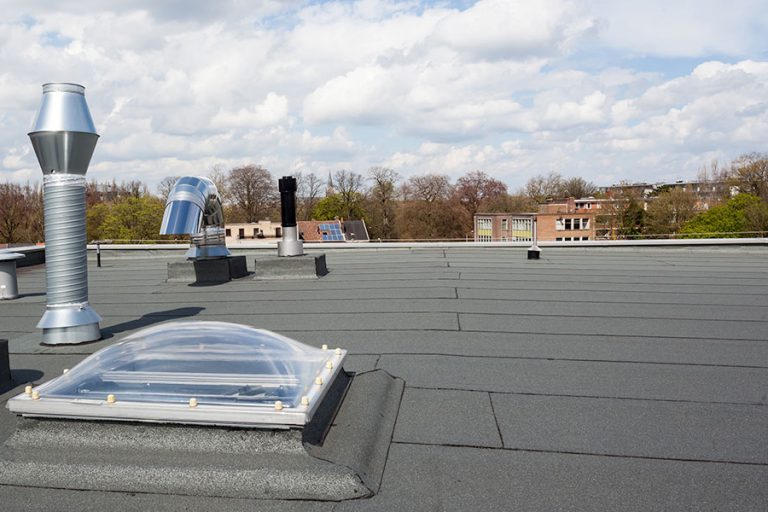
Curbs and penetrations lead by a wide margin. Every rooftop unit, exhaust fan, vent and conduit stub is a hole somebody flashed once. Sealant at a pitch pan has maybe five good years in it, and around here nobody's checking it at year six.
Then it's parapet and wall terminations. Counterflashing pulls loose, the termination bar sealant chalks out, and water gets behind the membrane where it can run a long way before it shows.
Drains and scuppers are next. A clamping ring that's loose, a lead flashing that's cracked, or a sump full of gravel, and now the wettest part of your roof is also the weakest part.
Last are field seams and punctures. On older membrane the T-joints go first. On newer roofs it's usually mechanical damage — a dropped tool, a dragged condenser, a satellite installer who screwed straight through.
If your building's already dripping, don't wait for a scheduled visit — our 24/7 emergency roofing line puts a crew on it tonight. Recurring leaks on a low-slope roof usually point at a bigger condition problem, which our flat roof repair page gets into. And if you'd rather stop finding leaks the hard way, a maintenance program catches most of them before the ceiling does.
Related: infrared roof moisture scanning — mapping how much insulation is actually wet.
The inspection and written findings are free. If the trace turns into a full day of controlled water testing on a large roof, we'll tell you up front what that costs before we do it. No surprises on the invoice.
Usually because they patched what they could see instead of tracing what the water was doing. A stain 40 feet from the entry point sends people to the wrong end of the roof, and mastic over the wrong spot still looks like work.
Sometimes that's the best time. Active water inside means we can watch the drip rate change while we work the roof. If the weather won't cooperate we recreate it with a hose, one zone at a time.
Then the repair scope grows. Wet insulation doesn't dry out under a membrane, it just spreads and eats R-value. We cut out the saturated area, replace it, and patch in with matching material rather than coating over the problem.
A live dispatcher answers 24 hours a day, every day. Active leaks get a temporary dry-in on that first visit so the building stops taking on water, then we come back and do the trace properly in daylight.
Tell us about the property and a dispatcher will call to schedule. No cost, no obligation.
Commercial leaks do not wait for business hours. A live dispatcher answers around the clock and we get crews moving the same night.