
Dew point math first
We calculate where condensation would land in the proposed stack. That decides whether the layer goes in and how much insulation sits above it.
Insulation and R-valueA vapor retarder is a low-permeance layer installed near the bottom of a roof assembly to stop humid interior air from pushing water vapor up into cold insulation, where it condenses. St. Louis sits in a mixed climate, so plenty of buildings here don't need one — and a handful absolutely do. John Beal Roofing runs the dew point numbers for your building before we decide, and detail the air seal so the layer actually works. Free inspections. Call (314) 429-6000.
This is one of the most argued-about layers in low-slope roofing, and most of the argument comes from people using the words loosely. A vapor retarder slows vapor diffusion. An air barrier stops bulk air movement. Air movement carries far more water than diffusion does, so in practice the layer only earns its keep if it's also sealed at every lap, edge, curb and penetration.
We're in climate zone 4 here, which is the awkward middle. Winters get cold enough to condense interior moisture inside a roof, but not so cold that every building needs the layer. So the honest answer to "do we need a vapor barrier" is that it depends on what happens under your deck.
We calculate where condensation would land in the proposed stack. That decides whether the layer goes in and how much insulation sits above it.
Insulation and R-valueSteel deck flutes get taped or a substrate board goes down first. A self-adhered sheet bridged over an open flute is not a barrier.
Curbs, drains, pipe penetrations, wall junctions and the perimeter. Miss one and you've built a chimney, not a barrier.
Leak detectionClass I, II or III is a number, not a brand claim. It goes on the submittal and we hand it to you with the closeout package.
Roof warranty guideAdding a barrier under an existing roof means a tear-off. You can't retrofit one from above and expect it to do anything.
Tear-off vs recoverA second low-perm layer above the insulation traps water between two barriers. That's how a dry roof becomes a swamp.
Wet insulation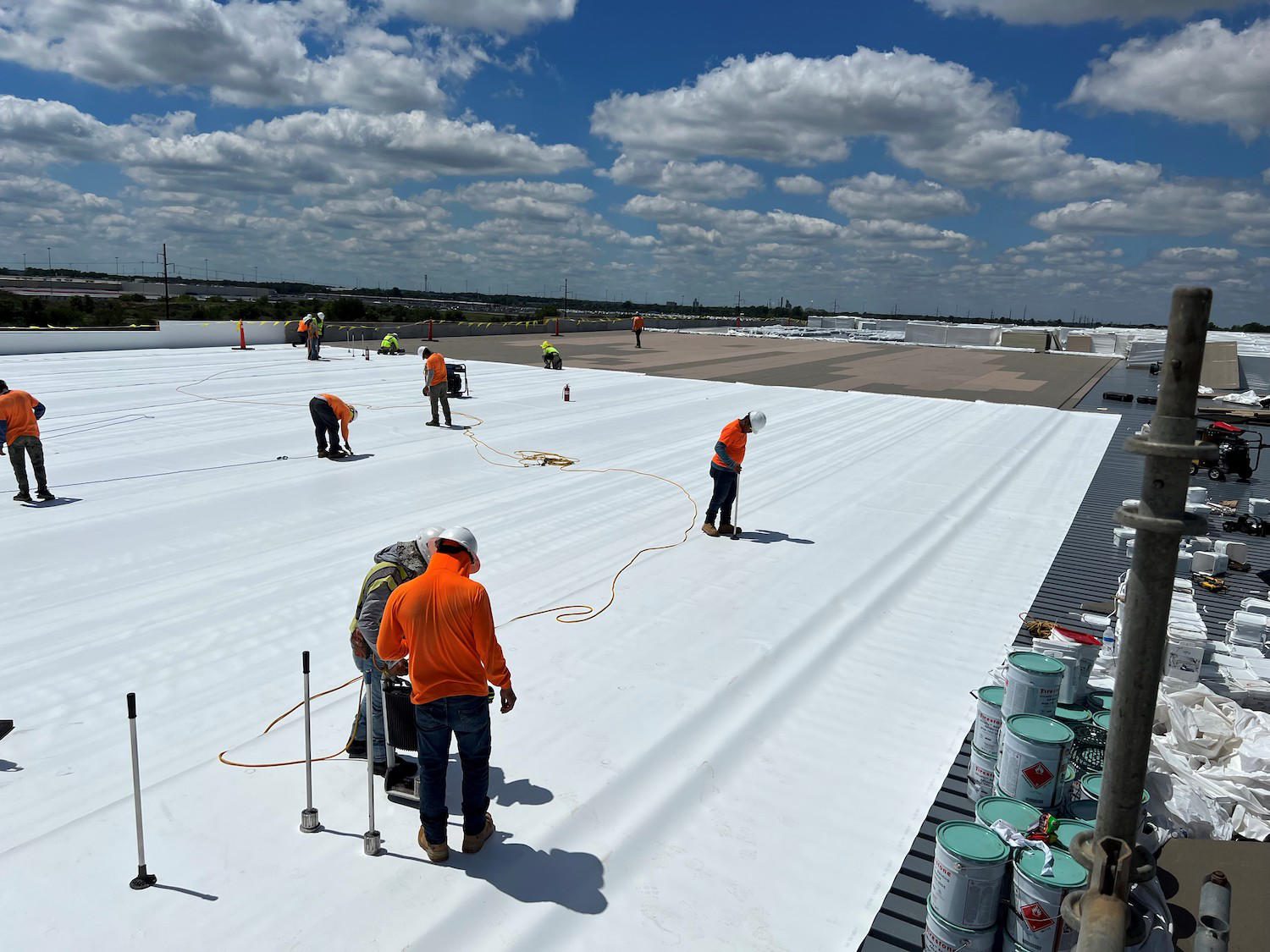
Steel deck gets swept and primed. If the flutes are wide, a thin substrate board goes down first so the sheet has something continuous to stick to. Concrete deck gets a moisture check — fresh structural concrete gives off water for months, and adhesives don't care about your schedule.
Then the sheet. Self-adhered modified sheets are what we use most, lapped per the manufacturer, rolled with weight so the laps are actually bonded and not just laid over each other. Torch-applied has its place, but not over combustible deck and not next to process piping.
Every penetration gets cut clean, primed and target-patched. The perimeter gets turned up and tied to the wall air barrier where one exists. This is slow, unglamorous work and it's where the whole layer is won or lost.
Insulation goes on above in staggered layers, and here's the rule that matters: enough R-value above the barrier to keep the barrier itself above the dew point. Skimp there and you've placed a condensing surface inside your own roof.
Plenty of buildings here don't need a vapor retarder, and installing one anyway costs money and adds a risk. A warehouse with no process moisture, a strip retail center, a standard office building — these run dry enough through the winter that the assembly handles it. A low-perm layer there mostly buys you a second surface water can get stuck against.
That's the tradeoff people skip. A vapor retarder near the deck is also a very good water holder. If a curb leaks upstairs, the water runs sideways along the retarder instead of dripping through and telling you. We've cored roofs where twenty squares of board were soaked and the ceiling below had never shown a stain.
So the decision comes down to interior conditions, the assembly, and the deck you've got. We'd rather run the numbers and say no than sell you a layer to look thorough.
One local wrinkle: freeze-thaw cycling here is brutal on any trapped water. We'll swing from 55 degrees to 20 and back inside a week in February. Water in a roof assembly expands, breaks the facer bond, and delaminates board. That's the mechanism behind a lot of roofs in St. Louis that "only had a small leak."
Related: brewery and distillery roofing in St. Louis and cold storage roofing — the two building types where this layer is not optional.
No. A vapor retarder slows diffusion through the material; an air barrier stops air from moving through gaps. Air movement carries much more moisture, so the layer has to be sealed at every lap and penetration to do real work.
No, and we'll say so. Warehouses, offices and retail centers with normal interior humidity usually don't. Pools, breweries, laundries and cold storage almost always do.
Not in any way that works. The layer belongs near the deck, under the insulation, so getting it in means stripping what's above it.
That depends on the interior humidity and the assembly above it. The point is that the number appears on the submittal and in your closeout documents instead of being described as "a vapor barrier" with no spec.
A core sample answers it in about ten minutes. We cut to the deck, read the layers, and patch it back the same day.
Tell us what the building does and we'll tell you whether the assembly needs a vapor retarder.
Commercial leaks do not wait for business hours. A live dispatcher answers around the clock and we get crews moving the same night.