
Meter before you price
Every square gets a moisture reading and a core. You can't bid a freezer roof off a walk-and-look.
Infrared moisture scanningA freezer roof fails from the inside out. The vapor drive runs downward instead of up, so humid Missouri air pushes into the assembly all summer and freezes inside the insulation instead of drying out. John Beal Roofing meters the board, cores the wet spots, corrects the vapor control, and phases tear-off bay by bay so nothing in the building ever leaves temperature. Free inspections. Call (314) 429-6000.
We work on refrigerated buildings all over the metro — the food distribution houses out around Earth City and Riverport, older cooler additions bolted onto Hazelwood and Bridgeton warehouses, and small blast freezers tucked into the back of a commissary kitchen. The roofs are almost never the same age as the refrigeration.
Here's the part that surprises owners. On a normal warehouse, moisture wants to travel up and out. On a freezer, the cold side is down, so the dew point sits somewhere inside your insulation stack, and every July the assembly is pulling water in. Seal that up wrong and you've built an ice-making machine that takes four years to show itself.
Every square gets a moisture reading and a core. You can't bid a freezer roof off a walk-and-look.
Infrared moisture scanningThe low-perm layer goes where the dew point calculation puts it, not where the last crew happened to leave it.
What wet insulation costs youWe open only what we can close. No freezer bay spends a night with the deck exposed.
Tear-off vs recoverTwo layers with offset seams and a cover board. Single-layer board on a freezer is a frost line waiting to happen.
Insulation and R-valueAround ammonia piping and relief vents we detail cold-applied or mechanically attached. No torch, no kettle.
Condensers, receivers and control panels get coordinated with your refrigeration contractor before we stage a thing.
Warehouse roofing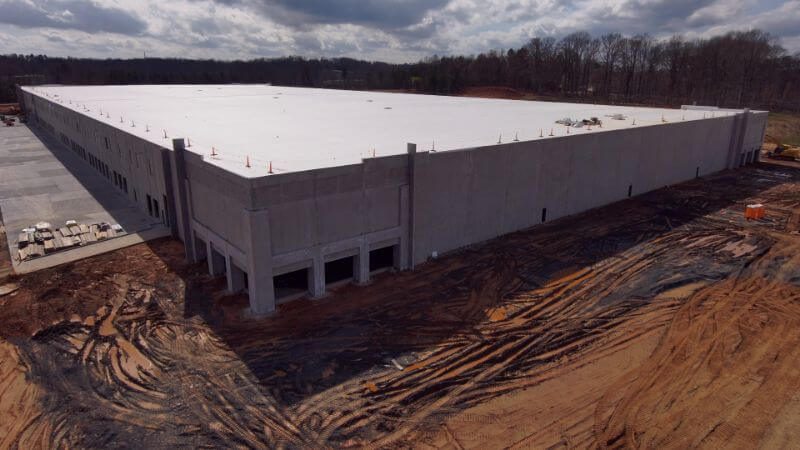
We start at the bay farthest from the dock so your forklift traffic never crosses our debris chute. One bay open at a time, everything dried in before the crew climbs down.
Existing board comes off in strips, not by the acre. If it comes up heavy and grey with a rime of ice in the facer, that tells us the vapor retarder below it either isn't there or got cut up by the last fastener pattern.
Deck gets swept, inspected and pull-tested before anything new touches it. On a 1970s steel deck over a cooler we've seen flute bottoms thinned to foil. That's a deck repair line item, and we'd rather find it on day one than argue about it in week three.
New assembly goes back as a system: primed deck, self-adhered vapor retarder lapped and rolled, two staggered layers of polyiso, cover board, then membrane. Fasteners get counted for uplift, not guessed.
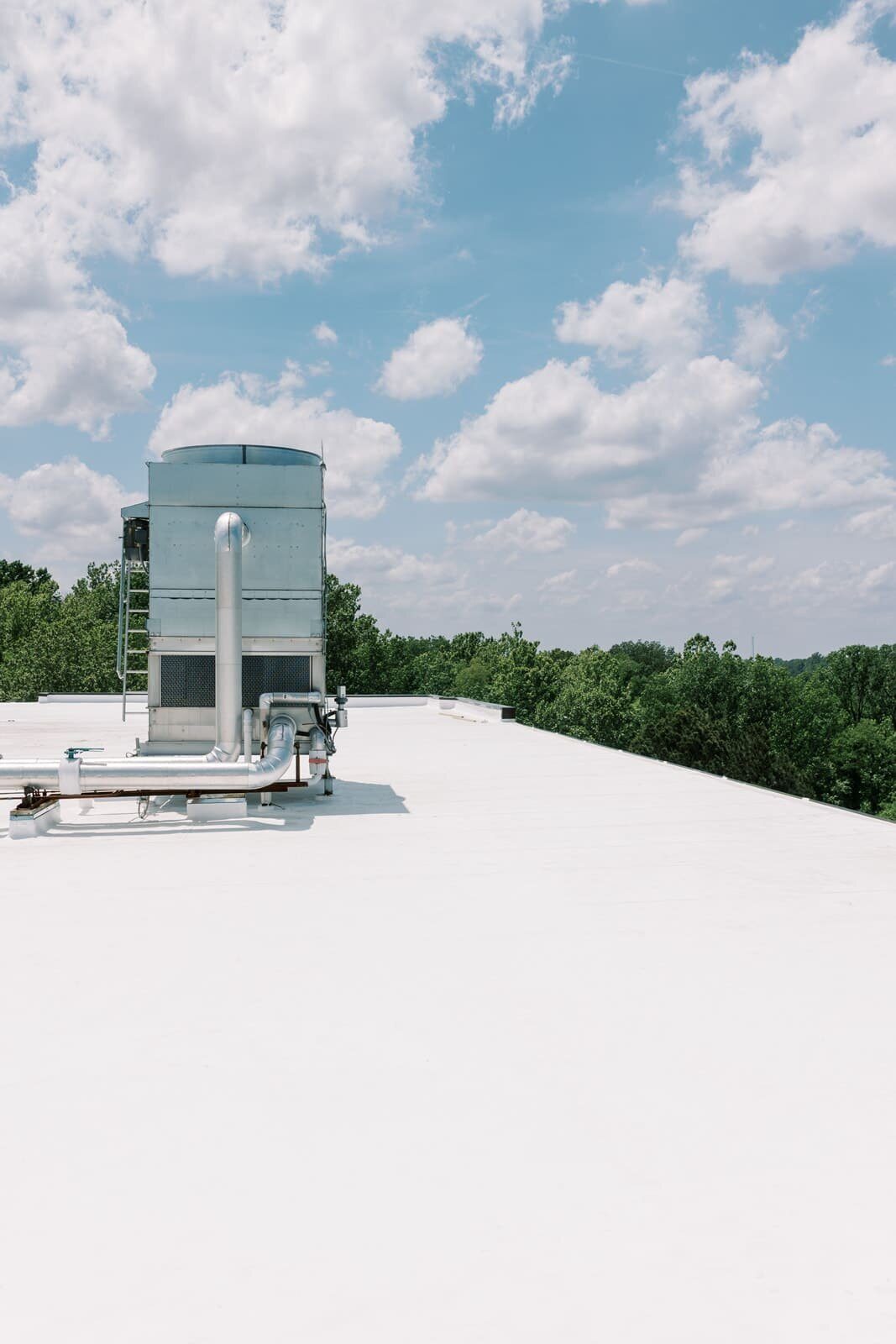
White TPO is the usual answer on a cold storage roof in this climate, and for a plain reason — reflective membrane cuts the surface temperature on a 98-degree August afternoon, which cuts the vapor pressure trying to shove its way into your assembly. PVC earns its price where exhaust or animal fat is landing on the roof, and we run it on plenty of food plants for exactly that. EPDM still has a place, but a black roof over a freezer makes the refrigeration work harder than it needs to.
Insulation is where cold storage stops looking like a normal commercial roof. Code minimum is a floor, not a target. On freezer space we're usually talking about a much deeper stack than the warehouse next door, in staggered layers so no seam runs straight through, with a cover board on top so hail and foot traffic don't dent the board into a low spot.
The thing nobody budgets for is the roof penetration count. A refrigerated building has more curbs, more pipe runs, more relief vents and more conduit than the square footage suggests. Each one is a detail, each detail is labor, and each one is where the next leak starts if it gets flashed casually. We count them on the inspection and they show up as real numbers on the proposal instead of hiding inside a per-square allowance.
Related: distribution center roofing in St. Louis and grocery store roofing — the same curb-heavy, never-closes problem on a bigger footprint.
No. We phase the work bay by bay and dry in what we open before the crew leaves, so the space below stays at temperature the whole way through.
That's usually condensation at the fasteners rather than a leak. Each screw is a thermal bridge through the assembly, and on a refrigerated roof that's where the dew point lands first.
Only if the insulation underneath meters dry. A coating seals moisture in, and on a cold storage roof the moisture has nowhere to go. We meter and core first, then tell you honestly.
Yes, and we ask for them early. Condenser units, relief piping and control conduit all get sequenced with them before we stage material on the roof.
Manufacturer coverage on the materials plus our own workmanship warranty. On qualifying work that workmanship warranty is a lifetime warranty, from a company that's been in St. Louis since 1947.
Tell us the building type and refrigerated square footage, and a dispatcher will call to schedule.
Commercial leaks do not wait for business hours. A live dispatcher answers around the clock and we get crews moving the same night.