
Water test in sections
We flood one zone at a time, low to high, with someone watching inside. That tells us the entry point instead of the guess.
Leak detectionIf a flat roof leaks along an exterior wall, the parapet is the first suspect — coping joints, failed through-wall flashing, a rusted reglet or base flashing that's pulled away from a rotted nailer. John Beal Roofing water-tests the wall in sections to find the real entry point, fixes the masonry before the roofing, and details the base and counterflashing so the repair lasts more than a season. Free inspections. Call (314) 429-6000.
St. Louis has an enormous stock of old masonry commercial buildings, and a parapet on every one of them. Downtown, Midtown, the Grove, Cherokee, Maplewood, the little brick storefronts up and down Manchester. Those walls have been freezing and thawing since before anybody now working on them was born.
Here's why parapet leaks get misdiagnosed so often. Water enters at the top of the wall, runs down inside the masonry cavity, comes out at a bed joint or the roof-to-wall junction, and lands ten or twenty feet from where it got in. Owners patch the stain side. We've followed water uphill on plenty of roofs where three previous "repairs" were all in the wrong place.
We flood one zone at a time, low to high, with someone watching inside. That tells us the entry point instead of the guess.
Leak detectionTuckpointing, brick replacement and cap repair happen before the membrane work. Reverse that order and you roof over the leak.
Continuous cleat, sealed and backed joints, correct slope back to the roof. Not a bead of caulk on a butt seam.
Gutters and drainageCut into the mortar joint, sealed and backer-rodded, with the counterflashing lapping the base flashing the right way.
Flat roof repairUp the wall to a proper height over a cant, terminated on a solid nailer. That's the detail that fails on almost every cheap repair.
Commercial roof repairIf the wall's been wet a while, the insulation next to it is wet too. We core to find the edge of it.
Core sampling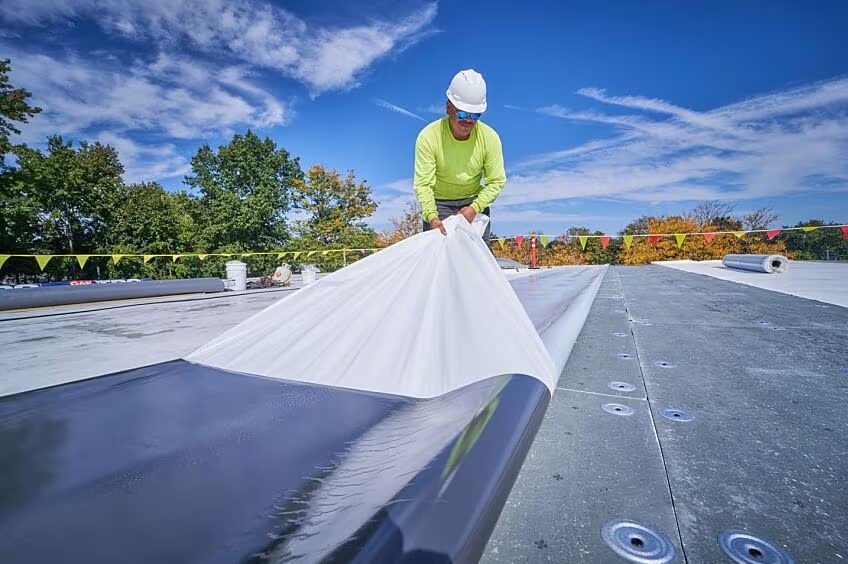
Strip the old base flashing back far enough to see the nailer. Rotted wood gets replaced with treated lumber, anchored into the masonry, not toenailed into whatever's left.
Open the wall where it needs opening. If through-wall flashing is gone, that's a masonry scope: pull a course, install new flashing with end dams, rebuild. It costs more than caulk. It's also the only version that stops.
Cant strip at the base, membrane turned up the wall, terminated in a bar with sealant behind it. Then counterflashing into a fresh reglet, lapped over the termination so water runs out instead of behind.
Coping goes back with a continuous cleat and joints that are backed and sealed, sloped inward so runoff heads to the roof drains rather than streaking the face of your building.
A parapet is the most exposed masonry on the whole building. Wind hits it from both sides, sun cooks it, and it's got no conditioned space behind it to moderate the temperature. So it swings further and faster than the wall below it, and it moves.
Then there's our freeze-thaw. We'll get rain on a Tuesday at 50 degrees, a hard freeze Wednesday night, and 60 again by Friday. Every one of those cycles takes water that's already in the brick and expands it. Faces pop off, mortar turns to sand, and joints you sealed two years ago open up with a hairline that's plenty for water.
Hail is the other one. Missouri takes real hail, and a soft metal coping cap dents into little bowls that hold water right over the joints. We've stripped coping where every fastener head had been driven through the metal by hail and each one was a hole.
Differential movement finishes the job. The roof deck expands at one rate, the masonry at another, and the membrane termination sits exactly on the seam between them. A base flashing glued tight with no allowance for movement will tear right along the top of the cant. That's why the detail matters more than the material.
Related: ponding water on a flat roof and commercial roofing in downtown St. Louis — both live next door to the parapet problem.
Water gets in at the top of the parapet, travels down inside the masonry cavity or along the deck, and exits at the first opening it finds. Twenty feet of travel is common, which is why we water-test instead of patching the stain.
It'll buy you a season, maybe two. Sealant on a butt joint is a maintenance item, not a repair. If the through-wall flashing under the cap is gone, caulk doesn't touch the actual path.
We scope and coordinate the masonry as part of the repair. Doing the roofing first and the tuckpointing later means paying to open our own work back up.
A live dispatcher answers 24 hours a day. Active leaks get a temporary dry-in immediately and a permanent repair scheduled behind it.
Sometimes, depending on the terms and whether the wall is considered part of the roof assembly. We read the warranty with you before we touch anything, so nobody accidentally voids coverage.
Tell us where the stain shows up inside and a dispatcher will call to schedule a look.
Commercial leaks do not wait for business hours. A live dispatcher answers around the clock and we get crews moving the same night.