
Fastener survey
We count backed-out and stripped screws bay by bay and check the washers. Missouri freeze-thaw works them loose a little more every winter.
A metal roof retrofit puts a new roof over an old screw-down metal roof without tearing it off — usually a single-ply membrane over flute-fill insulation, or new standing seam on sub-framing over the existing panels. John Beal Roofing checks fasteners, rust and purlins first, then recommends whichever option fits the building and the budget. Free inspections. Call (314) 429-6000.
There are a lot of 1980s and '90s steel buildings around St. Louis with through-fastened R-panel roofs. Shops in Fenton. Flex buildings in Earth City. Old ag buildings turned into contractor yards out past Wentzville. By now the neoprene washers under those screws have dried out and cracked, the end laps have started to rust, and every heavy rain finds another hole.
Tearing that roof off exposes everything inside to the weather. A retrofit doesn't. The old panels stay put and act as the deck, the building keeps working, and the new system goes on top. Which version makes sense depends on what's under the old metal, and that's what we look at first.
We count backed-out and stripped screws bay by bay and check the washers. Missouri freeze-thaw works them loose a little more every winter.
Surface rust is fine. Rust-through at end laps, gutters and the eave means that panel can't be trusted as a substrate, and we'll tell you so.
A retrofit adds weight. On older pre-engineered buildings we want purlin size and spacing confirmed before a single sub-purlin goes up.
EPS flute-fill blocks between the ribs, polyiso on top, then TPO either fully adhered or mechanically attached. A leaky metal roof becomes a flat-roof assembly.
TPO roofingZee or hat-channel sub-purlins fastened through to the existing purlins, insulation in the cavity, and a concealed-clip standing seam roof over all of it.
Commercial metal roofingIf the panels are sound and the trouble is mostly fasteners and laps, a reinforced coating system can buy years for less money.
Commercial roof coatings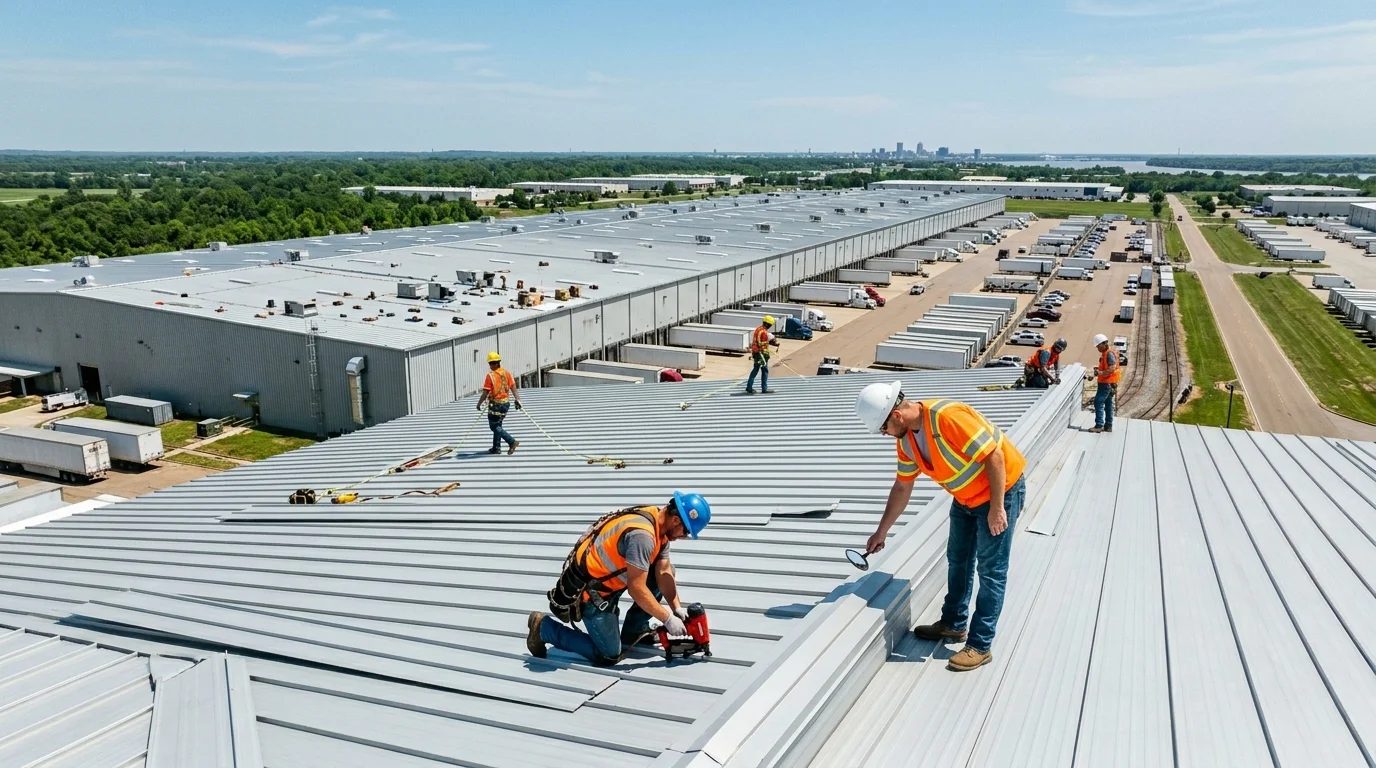
It starts at the screws. Every backed-out fastener gets driven home or swapped for an oversized one, because a loose screw under a new roof is still a loose screw. Panels that have rusted through get patched or replaced before anything covers them.
On a membrane retrofit, crews set flute fill into every valley so the board has full bearing, then lay polyiso across the top. Board thickness is set by the R-value you need — and under the energy code, a new roof over conditioned space has to meet current insulation levels. Then comes the membrane, the perimeter metal, and new curbs for whatever's sitting up there.
The standing-seam route takes longer up front. Sub-framing gets laid out to the existing purlin lines, shimmed to plane and string-lined, or the new panels oil-can and look wavy from the parking lot. Concealed clips let the panels move: a 100-foot steel run grows close to an inch between a January morning and a July afternoon.
Either way, the eave is where retrofits succeed or fail. The new roof is thicker than the old one, so the eave trim, gutter hangers and downspouts all move. We draw that detail before we price it. If you're still deciding whether to keep the old roof at all, our tear-off vs. recover page walks through the trade-offs.
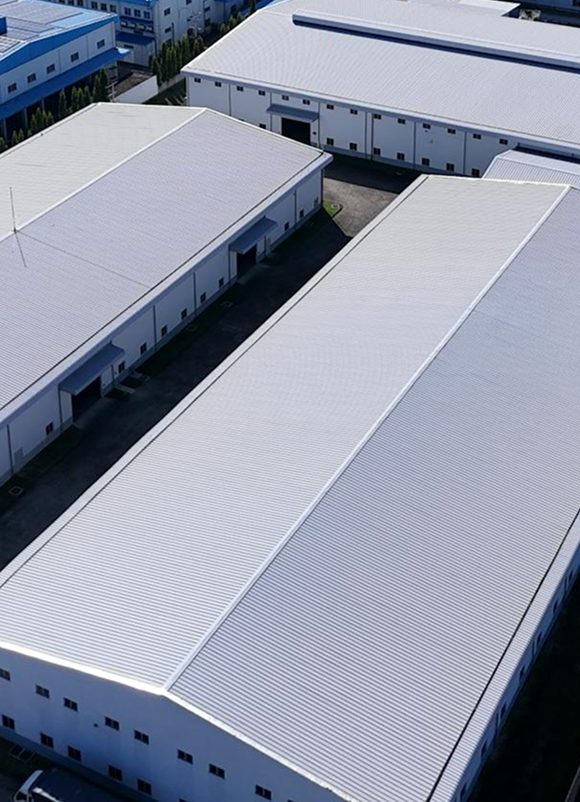
Related: warehouse roofing in St. Louis — where most of these old R-panel roofs are sitting.
For standing seam on sub-framing, usually yes, because it changes how load reaches the purlins. For a light membrane retrofit we'll at least confirm purlin size and spacing and tell you if an engineer's letter is needed.
In most cases, yes. The old panels stay in place the entire time, so the inside never sees open sky.
You skip tear-off labor and disposal but add insulation, and on standing seam you add framing. On a sound building the numbers are often close, and the retrofit wins on downtime.
It often helps a lot, since the insulation moves the cold surface away from the warm interior air. We'll look at how the building is used before promising anything — a wash bay behaves differently from dry storage.
Manufacturer coverage on the new system plus our lifetime workmanship warranty.
Tell us about the building and a dispatcher will call to schedule.
Commercial leaks do not wait for business hours. A live dispatcher answers around the clock and we get crews moving the same night.